00 Intro
Magic Circle
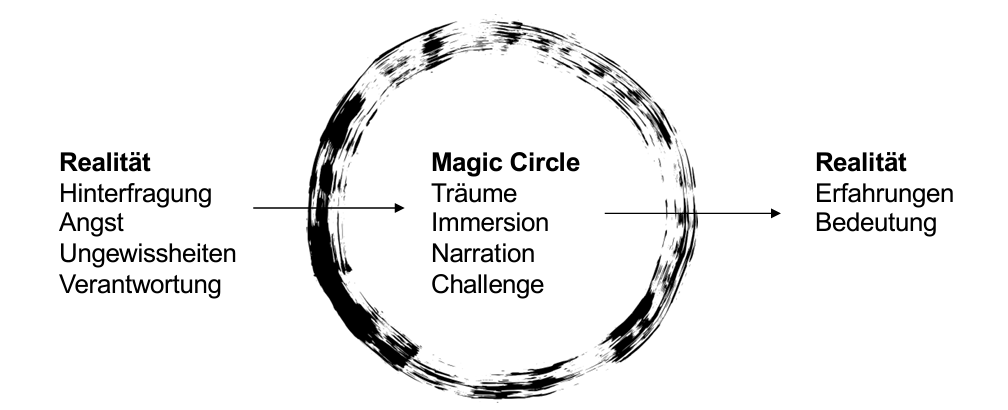
The magic circle is a concept in game design that describes the boundary between the game world and the real world. It is a metaphorical space in which the player is free to act and make decisions without real-world consequences. The magic circle is a key concept in game design because it helps to create a sense of immersion and engagement for the player.
On the outside of the magic circle is the real world, where the player’s actions have real-world consequences. Inside the magic circle is the game world, where the player can explore, experiment, and take risks without fear of real-world repercussions. The magic circle is a safe space for the player to play and have fun, and it is an essential part of what makes games enjoyable and engaging. When returning to the real world, the player can reflect on their experiences in the game world and learn from them, but the magic circle remains a separate and distinct space from the real world.
The magic circle is a powerful concept that can help game designers create compelling and immersive game experiences. By understanding the magic circle and how it functions, designers can create games that are engaging, entertaining, and meaningful for players.
Flow
The flow channel is a concept in game design that describes the balance between challenge and skill in a game. It is a metaphorical space in which the player is fully engaged and immersed in the game experience. The flow channel is a key concept in game design because it helps to create a sense of enjoyment and satisfaction for the player.
On one side of the flow channel is the player’s skill level, which represents their ability to meet the challenges presented by the game. On the other side of the flow channel is the level of challenge presented by the game, which represents the difficulty of the tasks the player must complete. When the player’s skill level and the level of challenge are well-balanced, the player is in a state of flow, where they are fully engaged and immersed in the game experience. If the challenge is too high, the player will become frustrated and disengaged, while if the challenge is too low, the player will become bored and disengaged.
Properties of Games
Games…
- are voluntary
- have conflicts
- have rules
- can be won or lost
- are interactive
- have challenges
- can create their own internal value systems
- engage players
- are closed, formal systems
The 4 Core Elements
The 4 key elements of game design are:
- Aesthetics
- Mechanics
- Story
- Technology
These elements work together to create a compelling and engaging game experience for players.
Mechanics
Mechanics are the rules and systems that govern how the game works. They include things like movement, combat, resource management, and progression.
Supported by technology which support mechanics.
Story
Story provides context and motivation for the player to engage with the mechanics and technology. It can be scripted or emergent.
Aesthetics
Aesthetics are the visual and auditory elements of the game that create the overall look and feel of the game. They include things like art style, music, sound effects, and animations.
Aesthetics directly influence how the player perceives the game.
Technology
Technology is the underlying framework that supports the mechanics, story, and aesthetics of the game. It includes things like game engines, programming languages, and hardware.
Noun/Verb Diagram
A noun/verb diagram is a tool used in game design to help identify the core elements of a game. Nouns represent the objects and entities in the game world, while verbs represent the actions and interactions that the player can perform.
By mapping out the nouns and verbs of a game, designers can identify the key elements that make the game unique and engaging.
Game Loop
The game loop is a concept in game design that describes the sequence of actions that occur in a game. It is a repeating cycle of input, processing, and output that drives the game forward and keeps the player engaged.
The game loop typically consists of the following steps:
- Input: The player provides input to the game, such as moving a character or pressing a button.
- Processing: The game processes the input and updates the game state accordingly.
- Output: The game displays the updated game state to the player, such as moving a character or playing a sound effect.
- Think: The player thinks about the current game state and decides on their next actions.
Compulsion loops are a subset of game loops that are designed to keep players engaged and coming back to the game. They typically involve rewards, challenges, and progression systems that encourage players to keep playing.
Goals
Goals are the objectives that the player must achieve in order to progress in the game.
Goals must be clear, achievable, and rewarding in order to keep the player engaged and motivated.
Game Space
Properties
- Discrete or continuous
- Dimensions (0D, 1D, 2D, 3D, …)
- Boundaries and transitions
- Flat or hierarchical
Linear
A linear game space is one that is structured in a linear or sequential manner, with a clear beginning and end point.
Examples: Monopoly, Super Mario Bros., Guitar Hero
### Grid A grid game space is one that is structured in a grid or lattice pattern, with discrete spaces that the player can move between.
Examples: Chess, Minesweeper, Pac Man
Network
A network game space is one that is structured as a network of interconnected nodes or spaces, with multiple paths and connections between them.
Examples: Quake, Doom
Plot
A plot game space is one that is structured in greater regions or zones, where a player can move freely within. Moving between regions may require a transition.
Examples: Assassin’s Creed, Metroid
Open World
An open world game space is one that is structured as a large, open environment that the player can freely explore and interact with.
Examples: Grand Theft Auto, The Legend of Zelda: Breath of the Wild
Hierarchical
Hierarchical game spaces are usually structured as mini-games.